

Meet Your Newest Coworker

Cannabis operations run on data.
Now AI wants a seat in the control room.
Dispatch 02
In technology circles, the concept of an ontology has become central to how large organizations structure their data. Companies such as Palantir Technologies use the term to describe a system in which information is organized around the real components of an operation rather than stored as disconnected records. Materials, facilities, production runs and finished products become objects within a model that reflects how an organization actually functions. The relationships between those objects matter as much as the data itself.
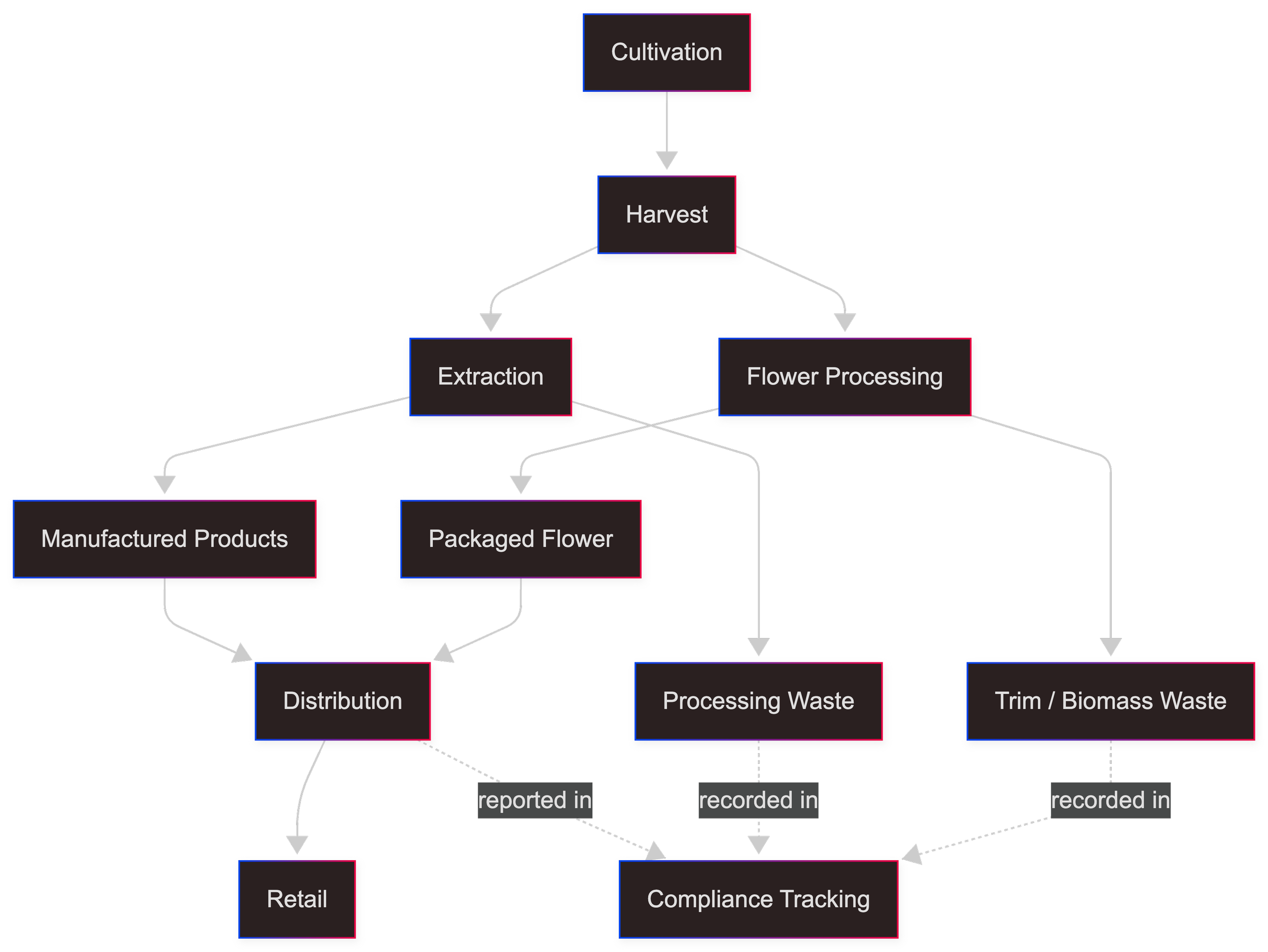
Figure 1:
A simplified model of cannabis production.
For cannabis operators, the components of such a system are already familiar. Cultivation produces harvests of biomass. That biomass moves into processing where it becomes input material for batches. Those batches feed extraction runs that generate oils, concentrates or intermediate products. The outputs from those runs are packaged, stored and eventually transferred to distribution. Each stage leaves behind records because regulators require precise tracking of plant material and finished goods.
Yet the information produced by this process rarely exists as a unified operational model. Compliance platforms track regulatory requirements. Inventory systems monitor packages and storage locations. Extraction teams maintain their own yield logs. Cultivation teams track harvest weights and plant performance. Each system captures part of the operation, but the connections between those records are often left to the people working inside the facility to interpret.
For years this fragmentation has been manageable. Operators have relied on manual reconciliation, spreadsheets and experience to assemble a picture of how production is performing. The problem is not that cannabis lacks data. If anything, the industry produces an extraordinary amount of it. The difficulty lies in connecting those records into something that reflects the production pipeline as a whole.
That challenge is beginning to take on a different significance as artificial intelligence tools move into operational environments. Systems such as Claude AI, developed by Anthropic, are increasingly designed to interact with internal data rather than operate as standalone chat interfaces. Features such as Claude Cowork allow the system to analyze documents, structured datasets and operational records that companies already maintain.
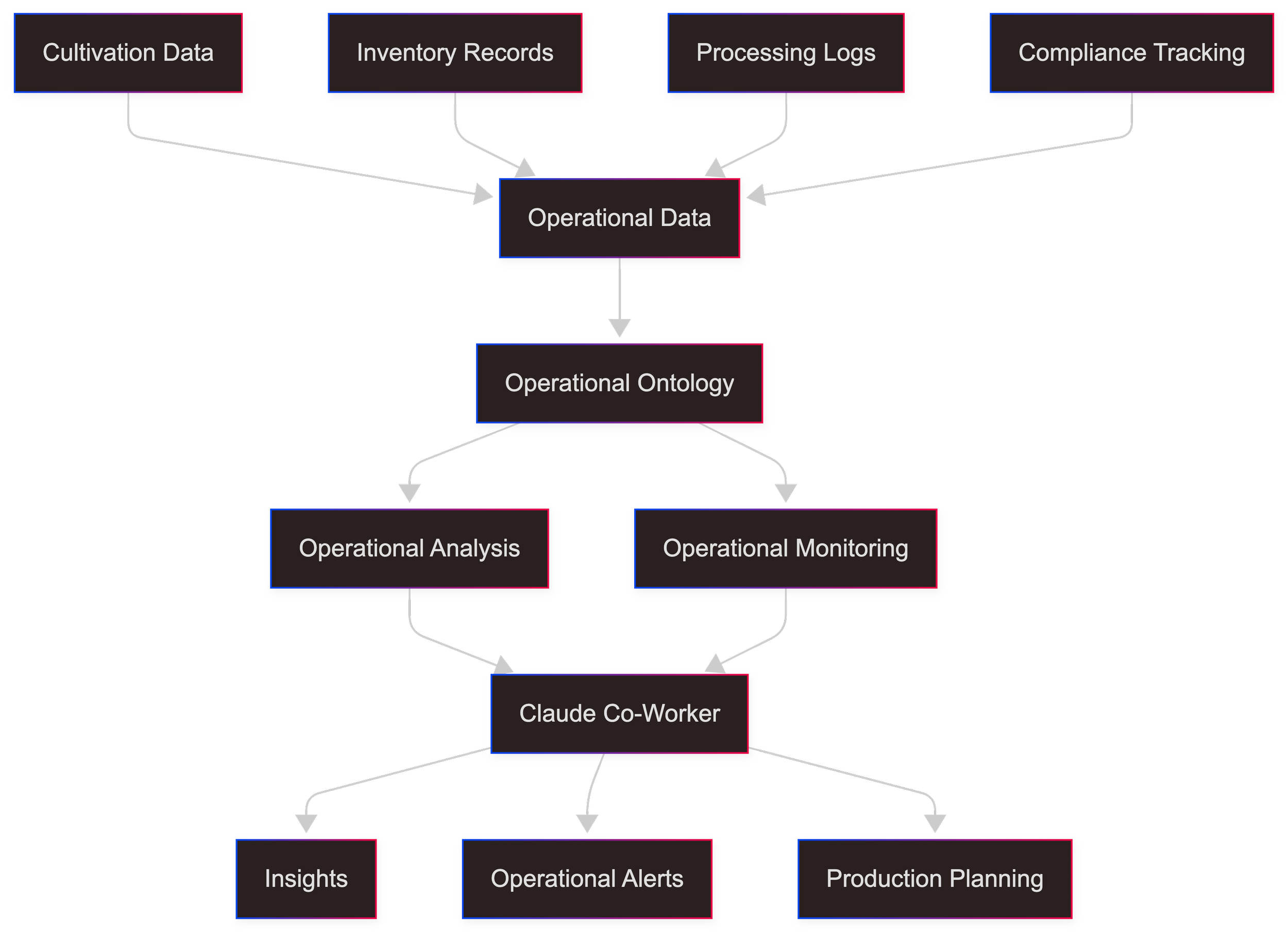
Figure 2:
How operational data becomes actionable intelligence.
The effectiveness of such systems depends heavily on how those records are structured. When data exists only as scattered spreadsheets and disconnected logs, an AI system sees fragments. It can process text and numbers, but it has little understanding of the relationships that define the operation itself. When the underlying structure reflects the real movement of material through a facility, the system can begin to follow those relationships in the same way a human operator might.
This difference in structure may prove more consequential than the introduction of the AI itself. In industries that have adopted operational ontologies, the focus of technological competition has shifted away from basic data collection and toward the ability to interpret and act on structured operational models. Organizations that can connect their systems into a coherent representation of production gain the ability to analyze performance, detect anomalies and automate routine analysis at a scale that manual processes cannot match.
Cannabis operations now find themselves approaching a similar threshold. Facilities already generate the records needed to construct such models. Harvest data, batch logs, extraction runs and inventory records all exist within regulatory and operational systems. The question is whether those records remain separate or become part of a structured framework that reflects the production pipeline from cultivation to finished goods.
If that structure emerges widely across the industry, the competitive landscape may shift quickly. Companies that rely on older reporting tools and manual reconciliation may find themselves operating at a disadvantage compared with facilities whose systems can evaluate yield performance, inventory flow and production efficiency in near real time. The difference would not lie in the volume of data collected but in the ability to organize and interpret it.
This dynamic resembles a pattern that has appeared repeatedly in other industries when new analytical infrastructure becomes available. The initial breakthrough often attracts attention, but the more lasting transformation occurs in the systems that organizations build around it. What begins as a new tool gradually becomes a requirement for remaining competitive. Firms that adopt the new structure first establish operational advantages that others feel pressure to replicate.
In cannabis manufacturing and cultivation, that pressure may take shape through the quiet adoption of structured operational models and the analytical tools that operate on top of them. The shift does not require replacing existing compliance systems or production workflows. Instead it involves connecting the records those systems already generate into a coherent representation of the operation.
Once that representation exists, tools like Claude can examine the relationships inside it in ways that resemble the work of experienced operators. The system can trace how harvest inputs move through batches and extraction runs, identify patterns in yield performance and surface discrepancies in inventory movement. The technology does not replace the expertise of the people running the facility, but it can assist them in navigating the growing complexity of regulated cannabis production.
Operator:
What fresh frozen inventory is available for solventless processing this week?

Claude:
3 harvest lots available

Lot 2241 – Cultivar: Papaya
Fresh Frozen Weight: 42.6 lbs

Lot 2247 – Cultivar: GMO
Fresh Frozen Weight: 38.2 lbs

Lot 2253 – Cultivar: Rainbow Belts
Fresh Frozen Weight: 27.4 lbs
As more facilities begin experimenting with these systems, the industry may find itself entering a period of rapid operational change. Data collection will remain necessary, but the real advantage will increasingly lie in how effectively that data is structured and interpreted. In that environment the most consequential addition to the workplace may not be a new piece of equipment or a new compliance platform. It may be the analytical system working quietly alongside operators, reviewing records and following the flow of material through the facility. For an industry built on careful tracking and complex production pipelines, that presence begins to resemble something more than a software tool. It starts to resemble a coworker…
